RBF, Elitism, and Crypto Purgatory
With crypto, you hit ‘send’, and your transaction goes to a kind of purgatory, and there it stays, waiting for the blockchain’s publishers to give it the thumbs up. That’s not the way I see it, mind you. That’s the widespread understanding. It’s no wonder that Computer Science grads push for shorter and shorter block-publishing times. Why spend too long in purgatory?
I wrote recently about RBF for Bitcoin (BTC) and how it made BTC less usable as money. Now, I want to focus on how RBF puffed up this ‘purgatory’ misbelief. I will show how RBF unwittingly served the goals of Bitcoin’s competitors.

Queuing up for an exam
Imagine that there is a queue of people for an exam. The exam is for computer repair, there are 1,000 questions, and if you get 90%, you will get a job for sure. Now, imagine that there are recruiters who go up to (good-looking) people in the queue and offer them jobs on the spot. Are the recruiters being reckless? Before you answer, learn all the facts that bear on the case:
- To get in the queue, the hopeful job-seeker must have answered five random questions from the actual test and nailed them all.
- A survey showed that 99.999% of computer techs hired from the queue turn out to be fine.
Now that you know these facts, you know that, for the recruiters, it’s still a bit of a risk, but not really on the scale of things.
Bitcoin Verification like Motte & Bailey security
Satoshi’s verification protocol is more nuanced than people make out nowadays.
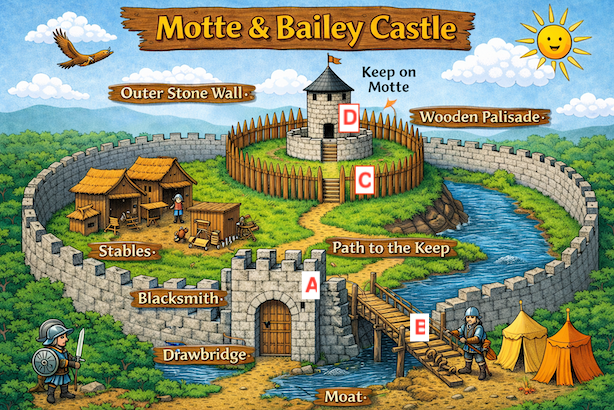
When you send a bitcoin payment, it’s not all or nothing. It’s not a case of being unsafe one minute and then completely safe the next. Rather, it’s like going through various step-by-step stages of defense in a castle: A, B, C, D.
- First, all the nodes check the payment for counterfeiting, [A];
- Layer Two, optional— more on this in the next post, [B];
- published on the blockchain, [C];
- finalized, when you know that the part of the blockchain with your payment can never be changed, [D].
This is why the analogy with the recruiters is apt. Step [A] weeds out the fraud, just like the random questions weed out the job-seekers in the queue trying to fake it. Some merchants choose to take a slight risk with crypto payments at this stage.1
People with the opposing view say that this is naive. Any chance of fraud is every chance of fraud. They have rooted for changes to cryptocurrency which minimize this time between [A] and [C]. Here is another way of framing it.
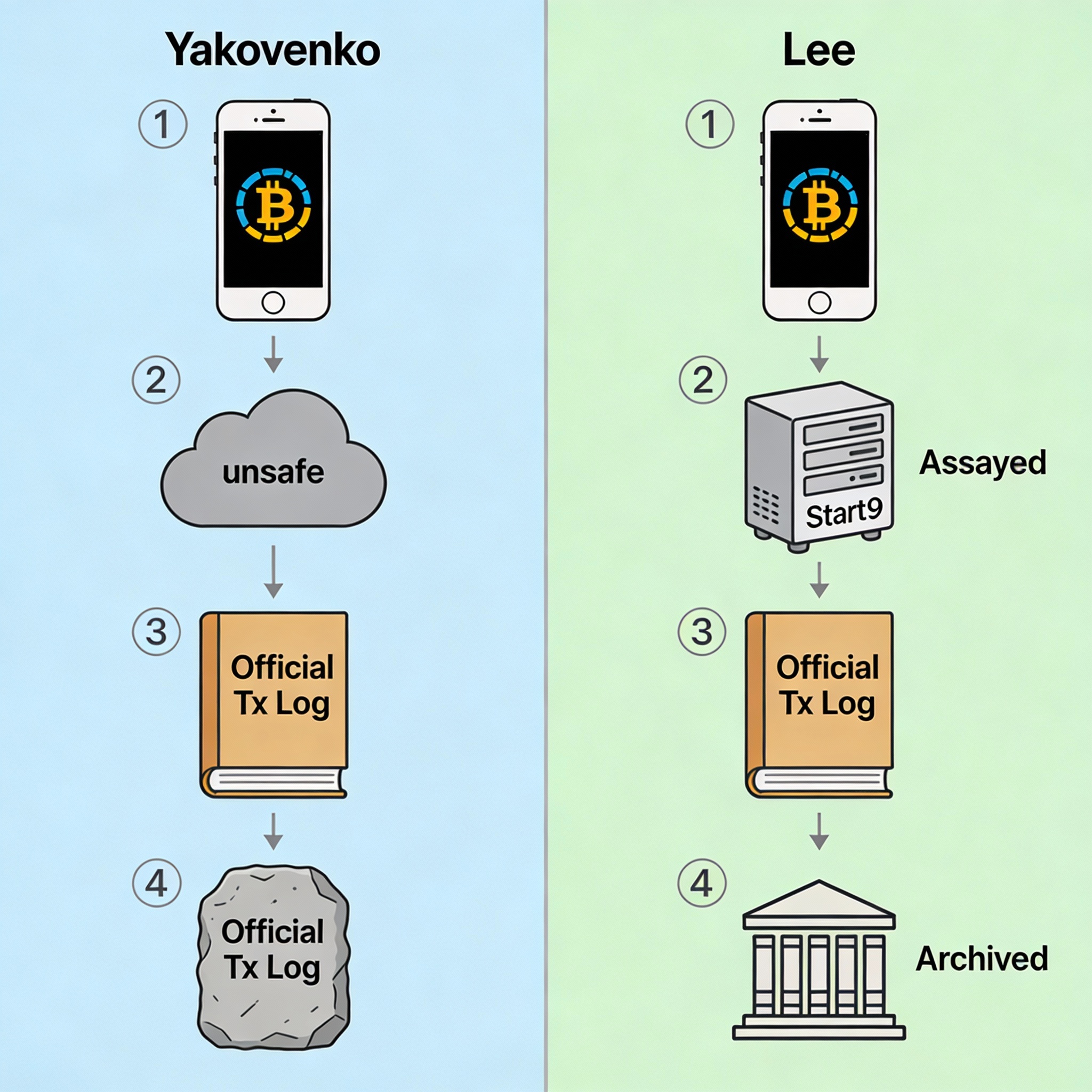
On the left side, there is a dark cloud representing the unsafe purgatory. It doesn’t matter who’s doing what at this time. On the right side, the side I agree with, the corresponding stage is represented by a Start9 home server. Now, you get a clue whither I’m heading.
Time between published blocks
It’s unsurprising that one would want to lessen a time one deems as ‘unsafe’. This column on the left, in the diagram above, I named after Solana’s leader, Anatoly Yakovenko. He thinks that any time over one second is crappy. Faster is better, right?
Tell that to Satoshi Nakamoto. Satoshi made that stage ten minutes long.2 At first glance, this seems woefully slow. It probably does err on the side of caution. The lack of speed is not accidental all the same. In a proof-of-work protocol, one can’t make the time when mining-nodes are vying to publish the next block too short. One must give them space so that they don’t step on each other’s toes. The reason is that it is possible for two mining-nodes to come up with right answers at the same time.3 The puzzle-game to publish the new block is not like a jigsaw puzzle; it’s like Scrabble. The topic is too big for this post (I will probably cover it in a future post), but, suffice to say, by my calculations, 100 seconds is the minimum, and 200 seconds is assured safe.
It’s more of a perception-thing. Slow node-runners in remote parts of the World should not feel disadvantaged. Satoshi’s choice of 600 seconds makes network speed a total non-issue.
Blockchains like Solana, Ethereum, and Tron, sidestep it cleverly. They change the whole design. There can be no stepping on toes, because each node applies for a time slot.
They don’t sidestep the issue of elitism.
Decentralization of nodes
This brings me to the main point. To be honest, collisions of new blocks are rare. It’s a rather geeky point. It flows into the wider matter of decentralization. I used the icon of the Start9 home server for a good reason. Start9 home servers are not crypto miners. Not everybody can ‘mine’ bitcoin. Even in the earliest days, people would give up because their computers were literally burning up. However, almost everybody can run a node. Start9 makes it easy to run a Bitcoin node. Everybody can guard the outer wall of the castle. Everybody can do an important job— the job of weeding out the counterfeit or corrupted transactions. This is the stage at which design-choices should favor cheaper tech and slower Internet.
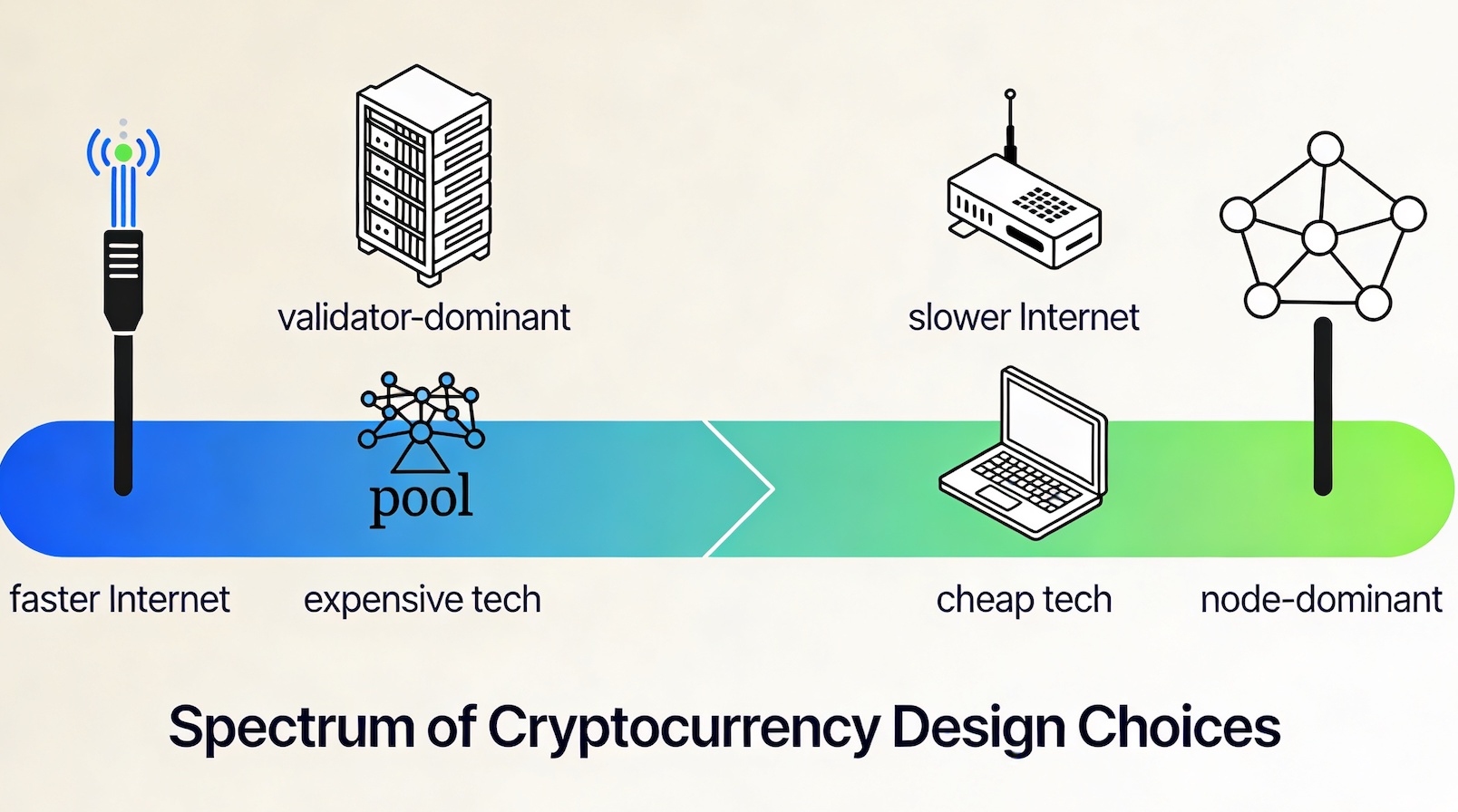
Here’s why RBF ‘Rekt Bitcoin Forever’. RBF meddled in that alleged purgatory time and struck a great blow against the nodes. It made them untrustworthy. It stopped them from doing a key-role properly. These nodes were by and large the plebs of the network. Hence, RBF was elitist. It took the wind out of the sails for Bitcoin’s greatest argument against the Silicon Valley type cryptocurrencies. In the spectrum-diagram above, RBF made it ultimately unfashionable to stand on the right.
RBF was a big middle finger from Silicon Valley to all the nodes in places like Tamale or Darwin.4
The Exception
There is one case in which it necessary to have very fast block updates.
Block updates of 1 second or less are necessary if the money involved is massive and the purpose is asset trading.
I am thinking of bots trading stocks. A buy or sell order of 50 million dollars can’t dilly-dally. It needs to get on the blockchain almost as soon as it leaves the app. Exchanges won’t touch it otherwise, and reasonably so. Worse still, if the blockchain is too slow, other bots can trade parasitically.
Given that this is the one exception, maybe you, like me, see the move in crypto towards Yakovenko’s ken as partly motivated by big money from Wall Street.
In the next post we will look at a solution for this exception which doesn’t muck up crypto as digital cash. We will also look at what you can do about it; namely, use either the Lightning network, or litecoin (LTC).
- Check out the previous post here. (Return)
- On average. There is a calculation to make sure that most successful new blocks appear as close to 10 minutes after the last one as possible. (Return)
- Effectively the same time. Two (or more) mining-nodes can, and do, occasionally come up with right guesses to the puzzle within milliseconds so that it is effectively the same because of the time it takes to reach other nodes all over the World. (Return)
- In Ghana and Australia, respectively. (Return)