Faker and Gayer
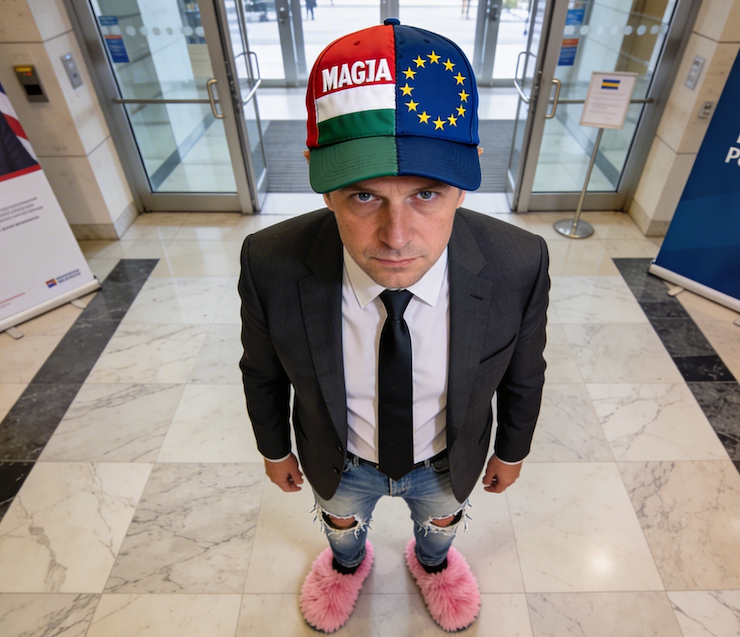
The Hungarian election was just won by a man described as a ‘conservative liberal populist’.1 Let me show you how inane that label is:
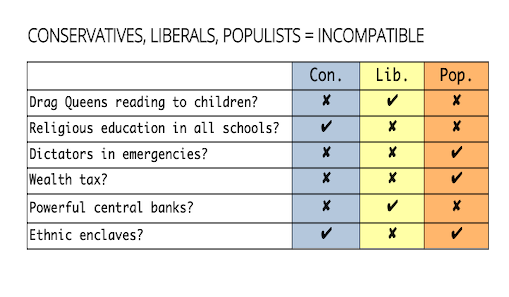
One cannot be a ‘conservative liberal populist’. One cannot mix them all up in a soup and get a drinkable soup. The ideologies have contrary stances on sundry issues. They will clash, and sooner rather than later— note the ‘hot button’ issues. What’s Peter Magyar’s stance on making religious studies compulsory? His answer will betray at least one of his alleged factions.2
Maybe this is a further descent into postmodern hell.
I have a sharper worry, to be honest, and that’s why I’m writing this. My worry is that I’ve seen this all-things-to-everyone tactic before.
Politicians being all things to everyone is a technocratic ruse.
Tony Blair was the king of it. He said: “My ideology is whatever works.” Come the invasion of Iraq in 2003, Mr. Blair suddenly found a very strong ideology in him, and it wasn’t ‘whatever works’; it was Globalist Imperialism with a dose of Protestant Evangelism.
Technocrats have this ruse to fool well-meaning voters, so they can push through their utopian agenda.
Typical politicians are mealy-mouthed. They try not to get caught out. They beat around the bush when it comes to controversy. This technocratic ruse goes much deeper. It goes to the heedful dearth of ideological positions.3
A more honest way would be to self-describe as a centrist. That’s if one is in good faith. That’s if one really wanted to try to bring together conservatives, liberals and populists.
Is this the first ‘conservative liberal populist’ of many? Things just got faker and gayer. Throw in the fact that his name means ‘Peter Hungarian’ in the Hungarian language. So fake, so gay. Populism is cool, right? I grant you, Magyar is a fairly common name; it’s like a ‘Peter English’ winning the British election; but when one is sniffing out con-jobs on the proles, one notices the telltale signs of oligarchs amusing themselves.
The blatantly fake Javier Millei in Argentina has schooled me on this. I began to smell a rat when he went to Davos and told them all to suck eggs, and then The Economist wrote favorably about it. Check out the cover. “My contempt for the state is infinite.” What a stupid thing to say.
I don’t know Hungarian politics. Maybe Viktor Orban ran a bad campaign. It happens. Maybe this Peter Hungarian chap will prove to be good for the country. I read somewhere that he is hard on corruption. I hope so. I’m not saying that I know things will turn out bad. Don’t make this about Hungary itself. It has just triggered a thought-process in my brain.
I’m saying: Always be looking for signs of fakery. Be on high alert for the next ‘conservative liberal populist libertarian moderate social-justice champion’. They are actors. They are there to push through things like A.I. mass surveillance and CFPCs.4
- The fact that this label comes from Wikipedia makes it even worse, because Wikipedia is a hotbed of Deep State meddling. (Return)
- My understanding is that Religious Studies is not compulsory in Hungary. One may choose Religious Studies or Secular Ethics. Seems a good policy to me, although given the history of Christianity in Hungary, I would say that it would be anti-Christian and wrong to leave Christianity out of the Secular Ethics curriculum. (Return)
- ‘While the Tisza Party officially avoids fixed ideological labels…’ from the Wikipedia article . (Return)
- Centralized Fiat Programmable Currency. This term is far more helpful than ‘CBDC’, Central Bank Digital Currency. (Return)