Bitcoin Is A Trojan Horse
The plebs fought the toffs and lost just like they did in AD 1381. I’m talking about the ‘BIP-110’ spam-wars in Bitcoin. The loss hammered home that Bitcoin is about as cool as Katy Perry nowadays. It’s sad to see. All the same, I’m not pessimistic. I will argue that Bitcoin is still on track to be a trojan horse. Troy in this analogy is the globalist banking cartel and we just need one alternative currency to open the gates.
Spam
The fight was over spam on the blockchain. The ‘plebs’ (i.e. node-runners) did not want to store someone else’s idea of a collectible meme on their home servers.
Think of it like this. Let’s say nearby road-workers store their sandwiches in my mailbox. I don’t want bits of tomato on my mail. Now, let’s say I ask the council to ban this. Imagine that the council not only does not do this, but also makes a law that forces mailbox-openings to be bigger. Then, waggish kids walking by put their food-wrappers in my mailbox. Sooner or later, there’s going to be a final straw. I’m going to tell my contacts to send me e-mail only.
It’s been one-way traffic in Bitcoin since 2019: More places to put spam, never less.
On the other hand, the anti-spam guys behave like puritans. Luke Dashjr, their leader, deemed as ‘spam’ the measly 80 bytes of extra data a paynym uses (infrequently). Paynyms are one of the most useful things in all Bitcoin!
Common-sense outcome
Here’s how I imagine things playing out in a world of common sense:
PLEBS:
Please stop the spam! This is not why anyone signed up for Bitcoin!
TOFFS:
The data needed to make the tiniest seeable picture is 700 bytes. Why don’t we cut the OP_RETURN data field back to 680 bytes?
PLEBS:
Still too much! The blockchain is filling up fast.
TOFFS:
320 bytes?
PLEBS:
Deal.
Vitalik's Trilemma
The best way to understand all this is with Vitalik’s Trilemma:1
A blockchain cannot excel at security and decentralization and scalability.
In other words, one can craft a blockchain to be secure and decentralized, or secure and scalable, or decentralized and scalable, etc. The moment you start adding features from the third horn, you get impaled on one of the first two horns.
Satoshi’s original outline of Bitcoin chose security and decentralization. It is not scalable. Bitcoin can’t handle more than about 3 transactions per second.2 It can’t handle much congestion without fees spiking to $5, $10, often more.
This has been known since the earliest days. Some folk (with big egos) take no heed of Vitalik’s Trilemma. Other folk push ways to scale Bitcoin’s blockchain, because it makes them more money, and they don’t care much about decentralization.
Decentralization is the neglected middle child in all this.
Before we go further, there’s an analogy I need to lay out.
The Medieval power balance
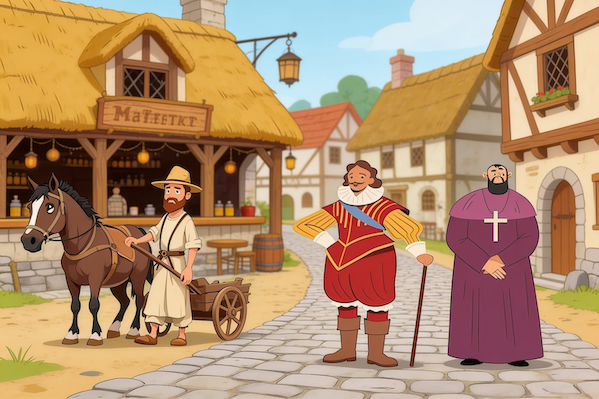
In the Medieval Era, noblemen were in control, because they owned the land, and it was an agricultural society. They didn’t have things all their own way. The priests and monks were independent and also owned land. The clergy could curb the nobility. Throw a third factor into the formula. I’m going to take some liberty and group together the serfs and the gentry.3 Without the serfs, the noblemen’s lands would go to ruin. Without the gentry, there would be no knights, and the noblemen’s lands would be plundered before too long.
In Bitcoin...
- the noblemen are like the orange-tie wearing types, who invest in it or start businesses based on it;
- the clergy are like the software developers;
- the serfs and gentry are the humble node-runners; I’ll call them ‘the plebs’ from now on.
Each group has different goals. Each group should balance the power of the others.
Vitalik’s Trilemma as a power struggle
Back to Vitalik’s trilemma. Each group tends to sharpen just one of the horns:
- Businessmen push scalability.
- Devs push security.
- Node-runners push decentralization.
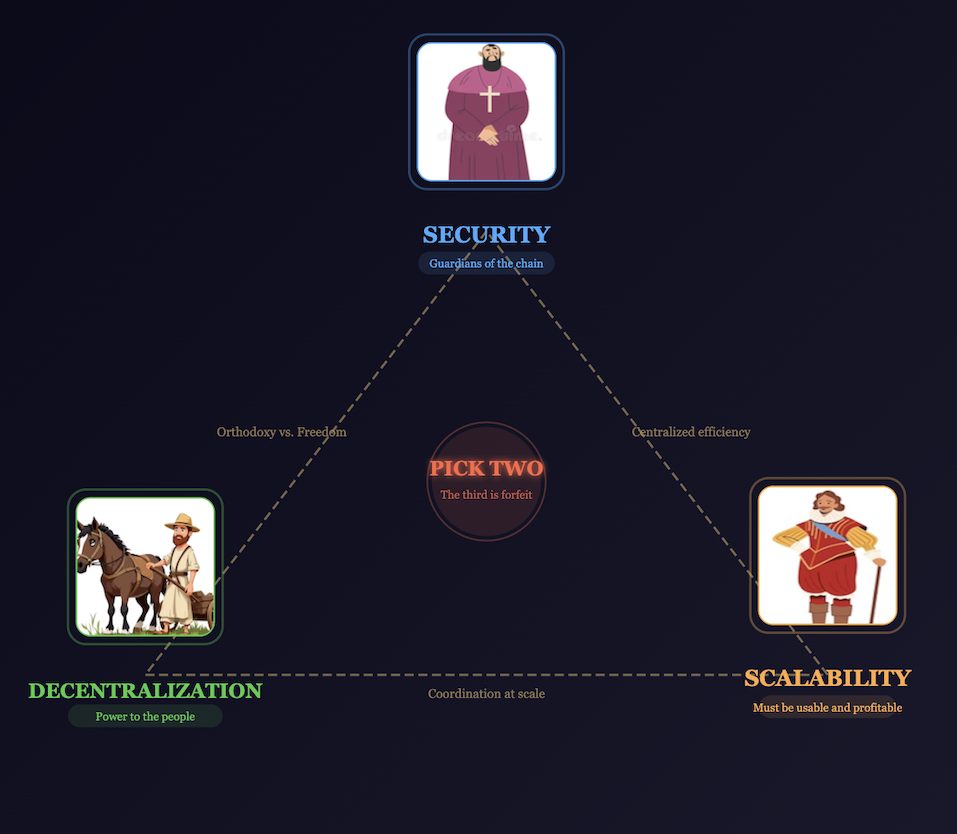
With this in mind, you can see the ‘progress’ of Bitcoin from a 30,000 feet view. Satoshi set up Bitcoin for security and decentralization, and it naturally pulled in the devs and plebs. As time went on, bitcoin (BTC)’s price went up. More and more businessmen got involved. They naturally pushed scalability. They teamed up with the devs. The devs did their part and made sure that the horn of security held steady. Given Vitalik’s Trilemma, the horn of decentralization had to give way. The plebs weren’t powerful enough. Every choice in Bitcoin since 2019 has been at the cost of decentralization.
We have a big power imbalance. Plebs have no say. Literally about ten people made the choice to blow out the OP_RETURN limit, causing this ruckus in the first place.
Trojan Horse
For sure, I would much rather that Bitcoin stuck to its original plan of being a secure, decentralized blockchain. This is naïve. There was no way that businessmen would stay away.
Indeed, for the good of all cryptocurrency, we need them.
Bitcoin Mechanic, one of the leaders of the plebs, says that Bitcoin has become a ‘reverse trojan horse’. He means that, instead of tricking the Trojans, the Trojans have tricked the Greeks, and infiltrated the horse.
I don’t think the trojan horse idea is dead. Stretching the analogy, my thinking is that once a Trojan Horse is within the city, and nothing bad happens, guards will let more in. At least one of those future trojan horses can be filled with Greeks who will open the gates.
Bitcoin (BTC) is a means to an end.
Don’t be fixated on the name ‘Bitcoin’
There’s one little (Scott Adamesque) reframing you can do to help you take all this trouble with a smile.
Satoshi Nakamoto did not invent ‘Bitcoin’; he invented bankless, uncensorable peer-to-peer digital cash.
What’s in a name? A lot. Not everything though. In the noughties, you could go see Guns ‘n’ Roses perform. It was just Axl Rose and a bunch of hired guns. The new songs didn’t sound like Guns ‘n’ Roses. Most of the original band played under the moniker ‘Velvet Revolver’. That was much closer to the real deal.
- Named after Vitalik Buterin. Before he founded Ethereum, Vitalik was one of the most insightful writers on Bitcoin. (Return)
- Some say four or five, but my experience of bitcoin (BTC) is that it usually works a bit worse in the real world than dogma states. (Return)
- The serfs were tenant-farmers who paid rent with their labor, 3-4 days per week. The gentry were small landowners who lacked the status of being lords or barons or higher. (Return)